
In the interconnected tapestry of global finance, the foreign exchange (forex) market stands as a pivotal force, facilitating the seamless exchange of currencies and shaping economic landscapes. As the world navigates an ever-changing panorama of political, economic, and social events, understanding the impact of these global occurrences on forex dynamics becomes paramount.
The forex market, a bustling hub of currency trading, serves as a barometer of global economic health and stability. Its intricate mechanisms are influenced by a symphony of factors, ranging from geopolitical shifts to economic data releases. Delving into the intricacies of this relationship, we embark on a journey to decipher how global events leave their indelible mark on forex market dynamics.
Forex Market: A Global Financial Hub

The foreign exchange (forex) market stands as a pivotal force in global finance, facilitating the seamless exchange of currencies, connecting economies, and fostering international trade. Its evolution over time mirrors the ever-changing landscape of global commerce.
In its nascent form, currency exchange was conducted through physical transactions, with traders exchanging one currency for another to facilitate cross-border trade. As global trade flourished, the need for a more structured and efficient system arose, leading to the establishment of formal forex markets.
Major Participants in the Forex Market
The forex market is a vast and dynamic arena, hosting a diverse array of participants, each playing a crucial role in shaping its intricate tapestry.
- Central Banks: Central banks, as guardians of monetary policy, wield significant influence over currency values. Their decisions on interest rates, quantitative easing, and other monetary policies have profound implications for currency valuations.
- Commercial Banks: Commercial banks serve as intermediaries between individuals, businesses, and the global financial system. They facilitate currency exchange, provide trade finance, and offer hedging solutions to mitigate currency risk.
- Institutional Investors: Institutional investors, such as hedge funds, pension funds, and asset management companies, actively participate in the forex market, seeking opportunities to capitalize on currency fluctuations and diversify their investment portfolios.
- Retail Traders: Retail traders, also known as individual traders, engage in forex trading for speculative purposes, aiming to profit from currency price movements. They utilize various trading strategies and platforms to execute their trades.
- Corporations: Corporations engaged in international trade and commerce actively participate in the forex market to manage currency risk associated with their cross-border transactions.
Impact of Global Events on Forex
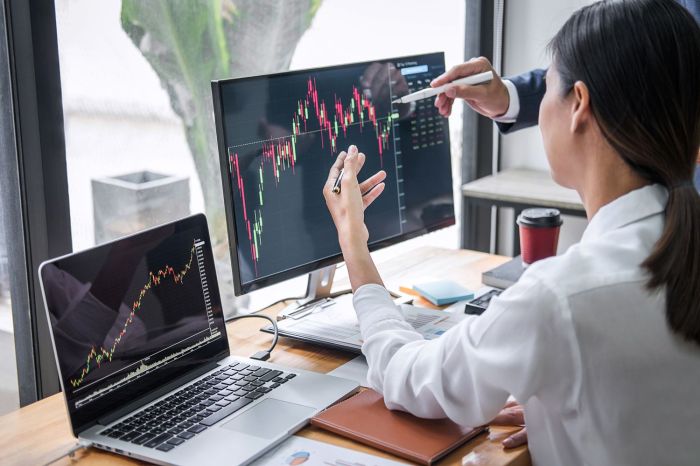
The foreign exchange (forex) market is a global decentralized market for the trading of currencies. It is the largest financial market in the world, with a daily trading volume of over $5 trillion. The value of currencies is constantly fluctuating, and these fluctuations are influenced by a variety of global events.
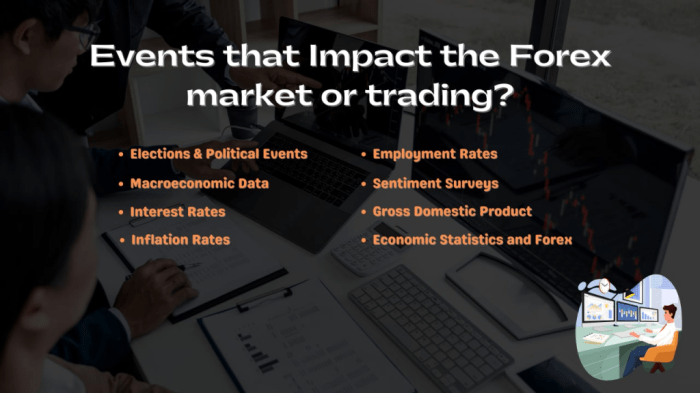
Global events can have a significant impact on forex market dynamics. Political events, such as elections or changes in government, can influence currency values. For example, if a country experiences political instability, its currency may depreciate as investors become less confident in the country’s economy.
Economic factors, such as interest rate decisions or GDP growth, can also affect currency exchange rates. For instance, if a country raises interest rates, its currency may appreciate as investors seek higher returns on their investments.
Risk Management in Forex Trading: Navigating the Market’s Uncertainties
Forex trading, while offering lucrative opportunities, comes with inherent risks that can quickly erode profits and lead to significant losses. Understanding and managing these risks is crucial for long-term success in the forex market.
Types of Risks in Forex Trading: Identifying Potential Threats
The forex market is influenced by a myriad of factors, both predictable and unpredictable, leading to various types of risks that traders must be aware of:
- Currency Risk: The primary risk in forex trading, arising from fluctuations in exchange rates, can result in losses if trades are not managed effectively.
- Interest Rate Risk: Changes in interest rates by central banks can impact currency values, potentially affecting the profitability of trades.
- Political and Economic Risk: Political instability, economic crises, and natural disasters can cause sudden shifts in currency values, leading to substantial losses.
- Liquidity Risk: The inability to quickly buy or sell a currency pair at a desired price due to low trading volume can result in missed opportunities or unfavorable execution.
Forecasting Forex Market Movements

Navigating the dynamic landscape of the forex market requires the ability to predict currency movements accurately. Technical and fundamental analysis techniques provide invaluable insights into market trends, enabling traders to make informed decisions and seize profitable opportunities.
Technical analysis, the study of historical price data, identifies patterns and trends that can indicate future price movements. Chart patterns, such as triangles, flags, and pennants, offer visual cues about potential market reversals or continuations. Moving averages, which smooth out price fluctuations, help identify overall market trends and potential support and resistance levels.
Chart Patterns
Chart patterns are recurring formations in price movements that can indicate potential market reversals or continuations. Some common chart patterns include:
- Triangles: Symmetrical triangles indicate consolidation before a breakout in either direction, while ascending and descending triangles suggest potential reversals.
- Flags and Pennants: These patterns signal a pause in a strong trend, often followed by a continuation in the same direction.
- Double Tops and Bottoms: These patterns indicate potential reversals, with a double top suggesting a bearish reversal and a double bottom suggesting a bullish reversal.
Moving Averages
Moving averages are calculated by taking the average price of a security over a specified period. They help smooth out price fluctuations and identify overall market trends.
- Simple Moving Average (SMA): The SMA is the most basic type of moving average, calculated by adding the closing prices over a specified period and dividing by the number of periods.
- Exponential Moving Average (EMA): The EMA gives more weight to recent prices, making it more responsive to market changes.
- Weighted Moving Average (WMA): The WMA assigns greater weight to more recent prices, providing a smoother average.
Oscillators
Oscillators are technical indicators that measure the overbought or oversold conditions of a market. They help identify potential turning points in price movements.
- Relative Strength Index (RSI): The RSI measures the magnitude of recent price changes to identify overbought or oversold conditions.
- Stochastic Oscillator: The Stochastic Oscillator compares the closing price to the highest and lowest prices over a specified period.
- Moving Average Convergence Divergence (MACD): The MACD measures the difference between two moving averages to identify trend changes and potential reversals.
News and Economic Data
Fundamental analysis, the study of economic and political factors that influence currency values, provides insights into long-term market trends. News and economic data, such as GDP growth, inflation rates, and interest rate decisions, can have a significant impact on currency movements.
By staying informed about economic and political developments, traders can make informed decisions about which currencies to buy or sell.
Trading Strategies and Techniques
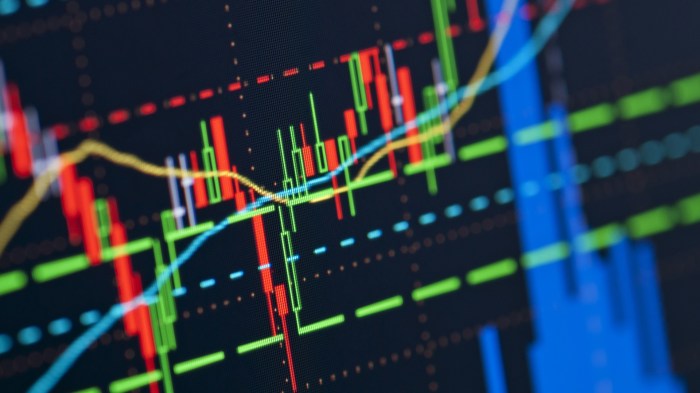
Forex trading offers diverse strategies that cater to varying risk appetites and time commitments. These range from short-term approaches like scalping and day trading to longer-term strategies such as swing trading.
Scalping, a high-frequency trading technique, involves executing multiple trades within a short period, aiming to profit from small price fluctuations. Day trading, as the name suggests, involves buying and selling currency pairs within the same trading day, seeking to capitalize on intraday price movements.
Swing trading, on the other hand, adopts a longer-term perspective, holding positions for several days or even weeks, with the goal of capturing larger price swings.
Successful Forex Trading Strategies
Successful forex trading strategies often combine technical and fundamental analysis. Technical analysis involves studying historical price data to identify patterns and trends that may indicate future price movements. Fundamental analysis, on the other hand, focuses on economic and political factors that can influence currency values.
A combination of both approaches can provide a more comprehensive understanding of market dynamics and potential trading opportunities.
Effective forex trading strategies often incorporate risk management techniques to minimize potential losses. These techniques include setting stop-loss orders to limit potential losses, diversifying portfolios to spread risk across multiple currency pairs, and maintaining appropriate leverage levels to avoid overexposure to market volatility.
Emerging Trends and Innovations in Forex Trading
The foreign exchange (forex) market is undergoing a transformative shift driven by technological advancements, regulatory changes, and evolving market dynamics. These emerging trends and innovations are reshaping the way traders navigate the global currency markets.
Technological Advancements:
Rapid advancements in technology are revolutionizing forex trading. Algorithmic trading, powered by sophisticated computer programs, has become prevalent. These algorithms analyze market data, identify trading opportunities, and execute trades in milliseconds, enabling traders to respond swiftly to market movements.
Artificial intelligence (AI) is another game-changer. AI-powered trading platforms and tools assist traders in making informed decisions by analyzing vast amounts of data, identifying patterns, and predicting market behavior. These technologies are enhancing trading accuracy and efficiency.
Regulatory Landscape:
The regulatory landscape of forex trading is evolving to keep pace with the changing market dynamics. Regulators worldwide are introducing stricter regulations to ensure market integrity, protect investors, and prevent financial misconduct.
These regulations include measures to enhance transparency, ensure fair competition, and safeguard client funds. The regulatory focus is on promoting responsible trading practices and minimizing systemic risks.
Conclusion

In the realm of forex trading, the interplay between global events and currency movements is a captivating dance, where political and economic factors orchestrate the rhythm of exchange rates. Understanding these intricate connections empowers traders with the knowledge to navigate market volatility and seize opportunities amidst the ebb and flow of global events.
As the world continues to evolve, the forex market remains a dynamic and ever-shifting landscape, beckoning traders to decipher its complexities and harness its potential.
